
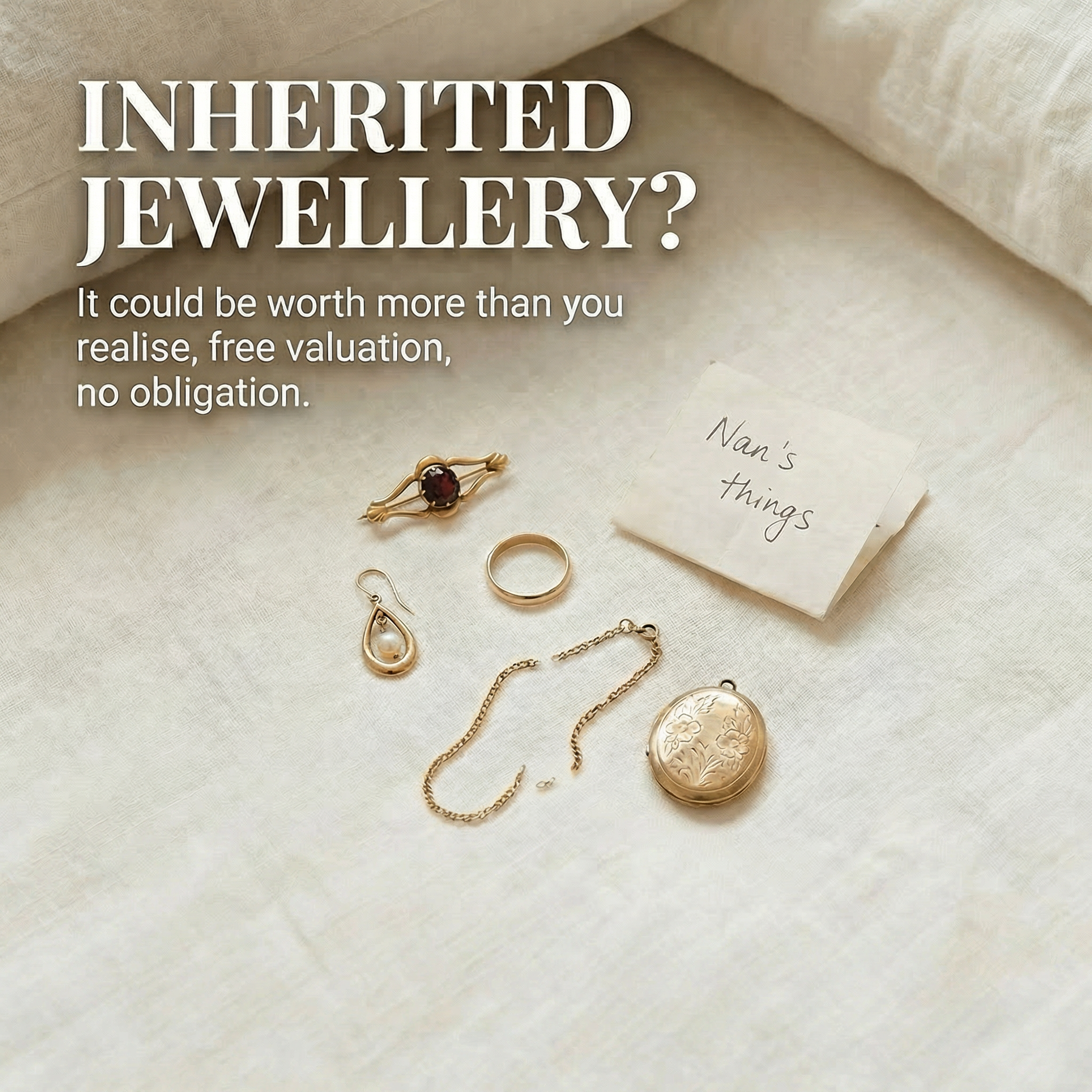
Every year, thousands of Australians inherit jewellery from a parent, grandparent, or other family member — and most of it ends up sitting untouched in a box. Selling inherited jewellery in Australia can feel complicated, emotionally and practically. But with gold at record prices, those inherited pieces may represent far more financial value than you realise, and turning them into cash can be simpler than you expect.
What Counts as Inherited Jewellery?
Inherited jewellery comes in many forms. Gold rings, brooches, chains, bracelets, and earrings are the most common. But inherited items can also include silver pieces, watches, loose diamonds, pearls, estate sets, and even coins or small bullion pieces passed down over generations.
Condition doesn’t necessarily matter. At The Gold Company, we buy broken jewellery, mismatched sets, single earrings, and items that are clearly old or worn. If it contains gold, silver, platinum, or diamonds, it has value — regardless of whether it’s in perfect condition.
Why Inherited Jewellery Often Has More Value Than You Think
Older jewellery — particularly pieces from the mid-20th century and earlier — was often made with higher gold content than modern mass-produced pieces. A ring that looks plain or old-fashioned may be 18 or 22 carat gold, making it worth considerably more per gram than a newer piece at 9 carats.
With gold at record highs, even modest inherited pieces can yield a meaningful return. A small collection of inherited gold jewellery — a few rings, a bracelet, and a chain — is not unusual to value at several thousand dollars in the current market.
Navigating the Emotional Side of Selling
Selling inherited jewellery is rarely a purely financial decision. Many people feel a sense of guilt or hesitation — as though selling means letting go of the person who left the items behind. This is completely natural, and it’s something we hear from customers regularly.
One way many people approach this is to separate the sentimental from the purely material. Keeping one or two pieces that carry genuine meaning, while selling the rest, is a perfectly reasonable approach. Turning unused inherited gold into cash that funds something meaningful — a family holiday, a home improvement, or financial security — can feel like a positive use of the legacy rather than a betrayal of it.
How to Prepare Your Inherited Items for Valuation
You don’t need to do much preparation before getting a valuation. Bring whatever you have — boxes, bags, individual pieces, or loose items. You don’t need to clean the jewellery, find original receipts, or know what it’s worth. Our valuers will handle all of that.
If you do have any documentation — certificates, original receipts, or valuations from a deceased estate — bring those along as they can sometimes provide useful context. But they are not required.
For guidance on managing a deceased estate more broadly, ASIC’s MoneySmart provides a practical overview of the process for Australians.
What Happens During the Valuation
When you visit The Gold Company’s Sydney showroom, our valuers will test each item using XRF analysis — a non-destructive technology that identifies the exact metal content without damaging the piece. We then weigh each item on certified scales and apply the current live market rate to calculate a fair offer.
Everything is done in front of you. We explain every step and answer any questions you have. Our goal is that you leave understanding exactly how we arrived at every number — not just taking our word for it.
Selling Inherited Jewellery From Outside Sydney
If you’re based outside Sydney, our Goldpak mail-in service lets you sell inherited jewellery from anywhere in Australia. We supply the packaging materials and cover the insurance, so your items are protected every step of the way. Learn more about our insurance coverage before you send.
The process is straightforward: order your free Goldpak kit, securely pack your inherited items, post them via Australia Post Registered, and receive a written offer within one business day of assessment. There is no obligation to accept — if you decline, everything is returned to you at no charge.
Start With a Free, No-Obligation Valuation
The first step is simply finding out what your inherited jewellery is worth. There’s no cost, no commitment, and no pressure. At The Gold Company, we’ve helped thousands of Australians navigate the process of selling inherited jewellery and walk away with a fair, transparent return.
Comments are closed